
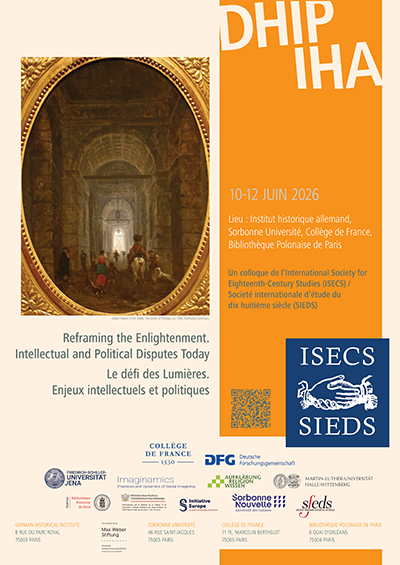
 Both ISECS and most of its member societies were founded when the Enlightenment movement of the 18th century enjoyed the highest reputation among scholars and perhaps even more so in society: as fighters for freedom of thought and self-determination, as advocates of progress and as pioneers of a democratic society. This of course was a view that experts always knew to be idealising, but it suited the mood of the democratisation push in Western societies and beyond in the last third of the 20th century.
Since around the turn of the millennium, the winds of scholars’s and society’s favour towards the Enlightenment have changed. Today, it seems that the society that the Enlightenment thinkers envisioned has not been realized. We are still facing fundamental inequalities: namely a power imbalance between the sexes, between elites and the people, between Europeans and the 'rest' of the world. Some exponents of the post-colonial agenda see the Enlightenment, not only in its racial doctrines but also in its standards of rationality, primarily as a justification of European colonial domination and exploitation. On the other side of the political spectrum, the Enlightenment is also criticised by those who see it as an arbitrary destruction of traditions or the self-serving empowerment of a small group of the intellectual elite. The current situation can be summarised in a variation of Jonathan Israel’s well-known book title: "Enlightenment contested again".
Anyone studying the 18th century is doubly challenged by this development. Firstly, the research in the 18th century is not unaffected by the respective social conditions. Secondly, the experts of the 18th century are able to substantially contribute to current debates on the role of the Enlightenment in the history of humanity. Organizing a conference, titled "Reframing the Enlightenment / Le défi des Lumières", ISECS is consciously taking on these challenges. This conference reflects the contemporary context in which we conduct our research and takes a well-founded position on the assessment of the Enlightenment in today's debates based on our research. The focus of the contributions should therefore be both on the historical subjects and on the assessment of the Enlightenment in our present day. The aim of the conference is to overcome the too simple positioning oneself either for or against the Enlightenment and to emphasise the complexity of both the Enlightenment as a historical phenomenon and its legacy for the present and the future.
Co-organisers, alongside ISECS (represented by its President Prof. Daniel Fulda, Halle): German Historical Institute Paris (Dr. Christine Zabel); Chaire d’Histoire des Lumières, XVIIIe-XXIe siècle, Collège de France (Prof. Dr. Antoine Lilti); Société Française d’Étude du Dix‑huitième Siècle (Prof. Christophe Martin), Bibliothèque Polonaise de Paris (Prof. Dr. Maciej Forycki); Prof. Florence Magnot-Ogilvy (Sorbonne Nouvelle); Prof. Dr. Chunjie Zhang (University of California, Davis)